
The Blind Spot Inside Every Building The Leak Nobody Saw
Nothing looked wrong.
There were no flooded bathrooms. No maintenance requests. No alarms.
Everything appeared perfectly normal, until DEFCON8 detected an usual flow pattern.
The cause turned out to be remarkably simple: a toilet installation that wasn’t sealing properly,
Quietly, continuously, it leaked.
In just one hour and forty-five minutes, 786 liters of water had been wasted and no one had noticed.
Without point-of-use monitoring, the leak would simply have surfaced weeks later as a higher utility bill, with no indication of where the water had gone.
It was a simple fault, but one that revealed a much bigger challenge.
As founder of DEFCON8, Javier Ray believes buildings have become remarkably intelligent when it comes to monitoring electricity, heating, occupancy and air quality. Yet, when it comes to water, one of their most valuable resources, most are still operating with very little visibility.
As DEFCON8 prepares to enter the UK market with Kantar Advisory Partners, we spoke with Javier about invisible waste, behavioural change and why he believes the future of water management starts with making the invisible visible.

Meet the Founder: A conversation with Javier Ray
"I Didn't Build DEFCON8 Because I Saw a Market."
"I'm an engineer, and I've always been worried about climate change and water scarcity," he says. "I wanted to contribute in a practical way."
That concern eventually led Javier to launch his first company, years before DEFCON8 existed.
Like many first-time founders, he believed the tools already available could solve the problem but they fell short.
The issue wasn't that buildings weren't measuring water, it was how they were measuring it.
"The existing solutions measured water at building level," Javier explains. "They gave averages, not behaviour. They told you what had happened, but not what was happening."
The more he worked with those systems, the clearer their limitations became. They could tell you how much water a building had used but not where it had gone, why consumption had changed, or whether there was a problem worth investigating. Most importantly, the information arrived too late to change anything.
Instead of abandoning the problem, Javier went back to the drawing board.
"DEFCON8 wasn't born from a market opportunity," he says. "It was born from frustration. I'd already tried to solve this problem once, and I'd seen exactly where the existing tools fell short."
Rather than creating another reporting platform, he decided to build the device he wished had existed all along.
Seeing Beyond the Main Meter
Buildings have never been smarter. They monitor electricity, occupancy, heating and ventilation and access in real time.
"Today, buildings have sensors for almost everything," Javier says. "Temperature. Occupancy. Energy. Access control."
"But when it comes to water, most buildings still rely on a single meter at the entrance."
That one sentence captures the problem better than any statistic. Imagine trying to manage a hotel's electricity consumption with a single monthly reading for the entire property : No floor-by-floor data. No room-by-room breakdown. No way of knowing where the energy is actually being used.
It sounds absurd. Yet that's exactly how water is still managed in many buildings today.
For Javier, that isn't just an information gap, it's a decision-making gap.
"What cannot be measured cannot be improved."
That idea became the foundation of DEFCON8: measure water where it's actually used, not just where it enters the building.
"People Think They're Only Using Water."
"When someone turns on a hot tap," he says, "they're not just consuming water, they're consuming the energy that heated it."
It's an obvious point, yet one most organisations still overlook.
Energy has been measured and optimised for decades. Water has not.
That's beginning to change. As organisations look for new ways to improve efficiency, water is becoming an operational issue as much as an environmental one.
That shift shaped the way DEFCON8 was designed.
Rather than measuring water alone, DEFCON8 captures both flow and temperature, allowing building managers to understand not only how much water is being consumed, but also the energy and cost associated with heating it.
It's a subtle difference, but one that transforms water from a utility into a source of operational intelligence.
Nobody Thinks in Cubic Metres
"Most people don't even read their water bill," he says. "And when they do, it's measured in cubic metres. Nobody thinks in cubic metres."
Most of us couldn't tell you how many cubic metres of water we used last month. Even fewer could picture what that number actually looks like.
And even if we could? The information arrives too late.
By the time the bill lands, the showers have been taken, the washing has been done, and any unnoticed leak has already become an expensive one.
"A bill tells you what you've already consumed," Javier explains. "It doesn't help you change what you're consuming right now."
Instead of asking people to interpret a bill weeks after the event, DEFCON8 shows consumption while the water is still running.
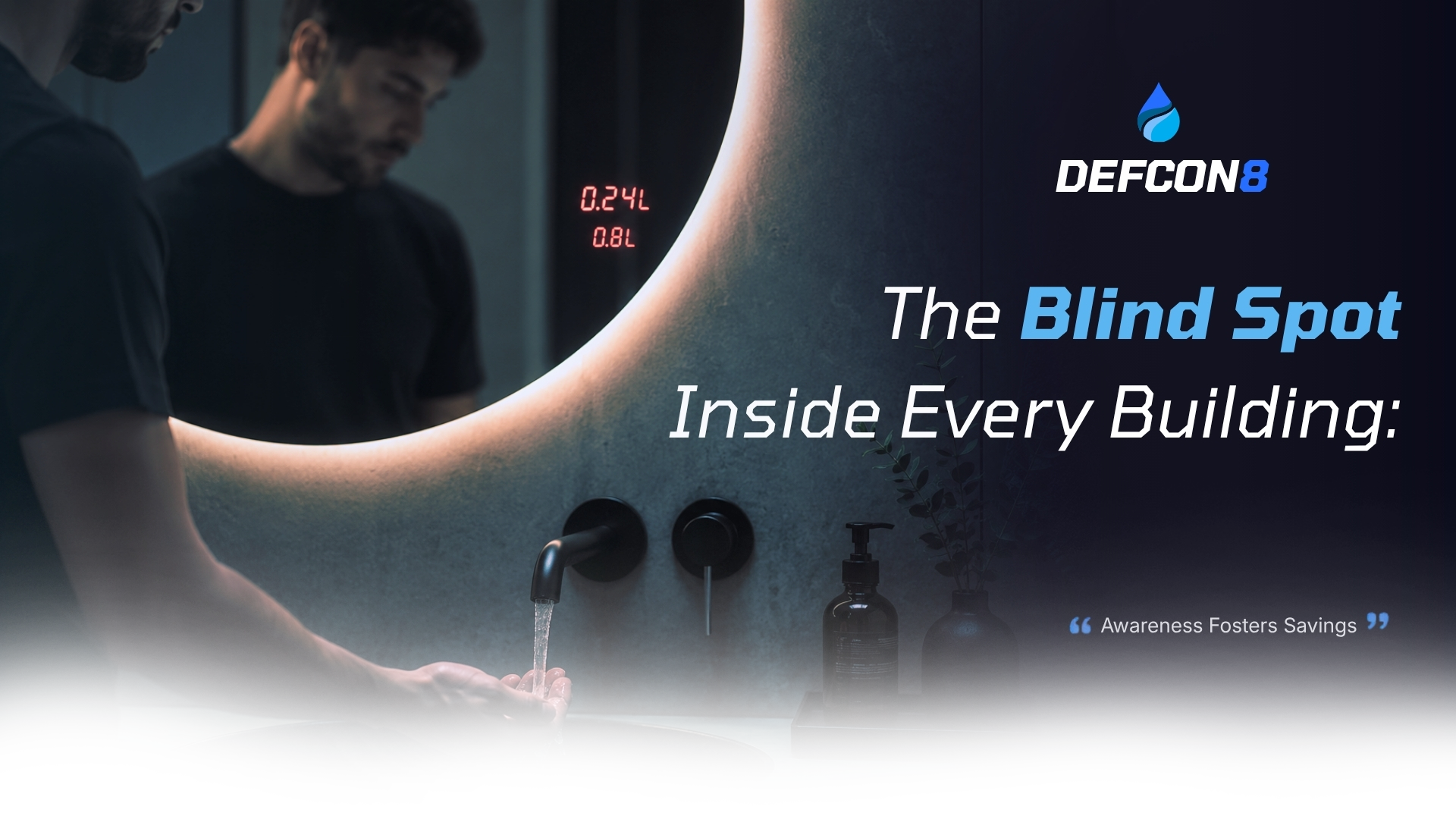
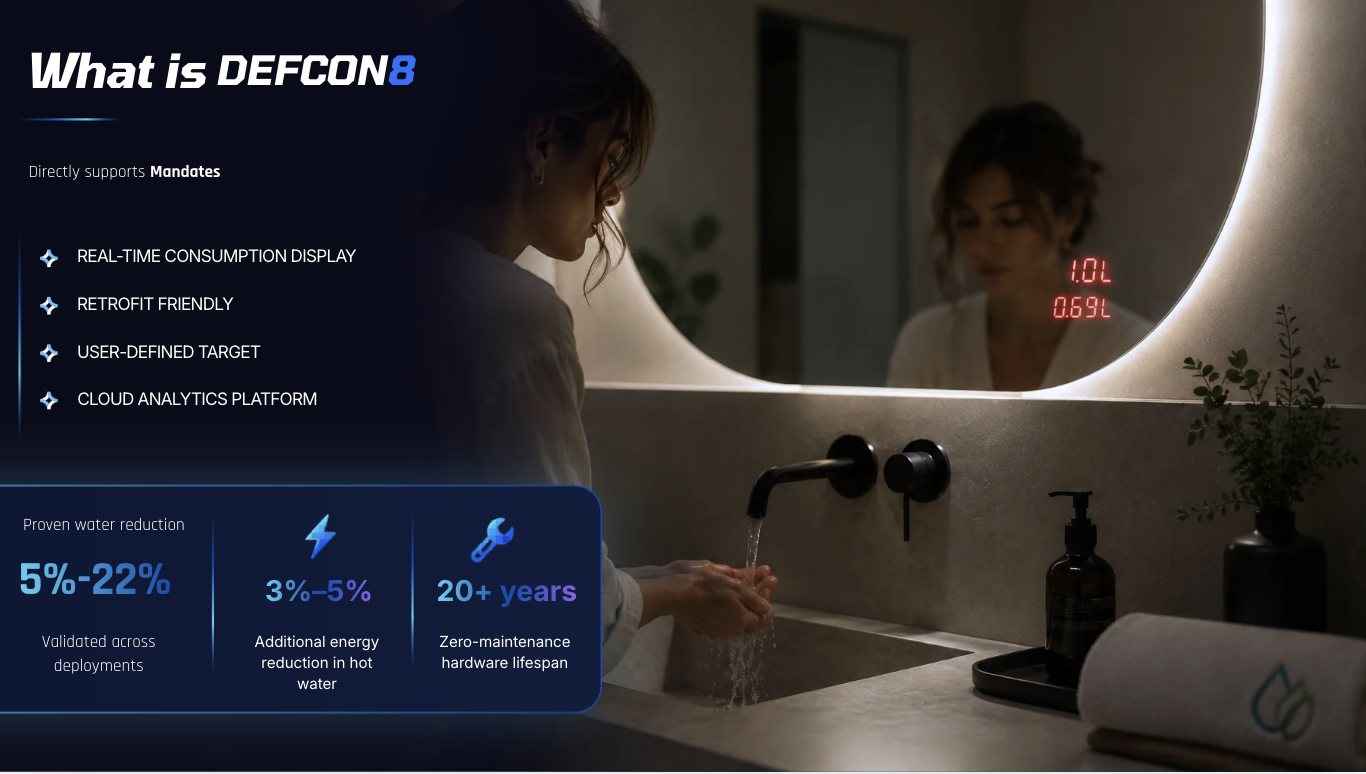
A small display, discreetly integrated behind the bathroom mirror, activates when a tap is turned on. It doesn't interrupt the experience or ask people to use less. It simply makes something invisible... visible. At the same time, the same information is sent to a cloud platform, giving building managers real-time visibility across an entire property.
"The water flows exactly the same," Javier says. "What changes is that people can finally see it."
For him, that's where behaviour starts to change - not through restriction, but through awareness.
What Happens When People Can Finally See Water?
Most water-saving initiatives ask people to change something; take shorter showers, accept lower pressure, use less water.
Javier wanted to test a different idea: what if the experience stayed exactly the same?
Hotel Estimar in Valencia became the perfect place to test that idea: What if you didn't change the water experience at all but simply gave people better information?
There were no flow restrictors. No timed showers. No signs asking guests to conserve water.
The showers felt exactly the same.
The taps worked exactly the same.
Guests weren't asked to sacrifice comfort. The only thing that changed was visibility.
Over the following year, the hotel reduced its water consumption by 22%, saving more than 1.4 million litres of water, while maintaining a 90% guest satisfaction rate.
"People don't need less water," he says. "They need better information."
Perhaps the strongest endorsement came afterwards. The hotel chose to continue working with DEFCON8. For Javier, that's a far more meaningful metric than a successful pilot.
The technology hadn't just proved an idea, it had delivered lasting value.
Not Another Water-Saving Device
For Javier, DEFCON8 isn't another water-saving device. In fact, he doesn't think it should replace the solutions already on the market.
"We don't compete with flow restrictors, aerators or other efficiency technologies," he says. "We complement them." The platform can be the data layer that measures the real impact of any other solution installed in the building.
Buildings around the world are already investing in more efficient fixtures and water-saving initiatives. The challenge isn't always finding new technologies-it's understanding whether the ones already installed are actually delivering the results they promised.
That's where Javier believes DEFCON8 fits.
Rather than asking organisations to change the measures already in place, DEFCON8 provides the data layer that allows building managers to measure their real impact, compare interventions and identify where further improvements are needed.
In some installations, the platform goes one step further. If DEFCON8 detects abnormal water flow outside predefined hours, or consumption beyond a configured threshold, it can automatically trigger a shut-off valve, preventing a leak from continuing before anyone even arrives on site.
According to Javier, it’s not about detecting a problem, it’s about detecting it while there’s still something that can be done about it.
"If another solution is reducing water consumption, we should be able to measure that. Our role is to provide the evidence."
It's a refreshingly practical philosophy.
Not every problem needs another invention.
Sometimes it needs a better way of measuring the ones we've already solved.
Why the UK?
The UK isn't simply DEFCON8's next market.
It emerged from a deliberate assessment of where the conditions for the technology are beginning to converge. “We evaluated several European markets and the UK came out on top because of a convergence of factors.”
For DEFCON8, those factors include growing pressure around water resilience, stronger expectations around metering and responsible water management, and large building-intensive sectors already working to reduce energy use, carbon emissions and operating costs.
Hospitality is a natural entry point, but the opportunity extends across healthcare, student accommodation, commercial real estate, schools, sports facilities and residential developments. The common challenge is the same: water is being used across multiple spaces by multiple people, with very little live visibility of where it is going.
"The UK has a strong culture of innovation and sustainability," he says. "There's a willingness to adopt technologies that deliver measurable results."
That's what made the partnership with Kantar Advisory Partners a natural next step.
KAP is supporting DEFCON8’s UK market entry by translating proven technology and deployment results into the partnerships, pilot opportunities and commercial relationships needed to build traction in a new market.
As DEFCON8 expands into the UK, the goal isn't simply to introduce another piece of technology.
It's to help organisations see, measure, and act on a water challenge they have largely been managing in the dark.
Looking Ahead
Success, for Javier, is changing the way buildings think about water.
He imagines buildings where understanding water is as routine as understanding electricity, where facility managers can spot inefficiencies before they become costs, where sustainability decisions are based on live information rather than monthly reports, and where water is finally managed with the same attention we've long given to energy.
DEFCON8 is now preparing the next generation of its system, including WiFi connectivity and a 4.3-inch LCD display designed to simplify installation and provide richer information at the point of use. As the platform develops, the ambition is to turn water-flow and temperature data into increasingly useful operational insight for buildings and their users.
"What cannot be measured cannot be improved."
DEFCON8 wasn't built to make people use less water.
It was built to make something invisible visible. Because once people can see it, they can start making better decisions.
For DEFCON8, that is the real innovation. Not asking people to sacrifice comfort, but giving them the visibility to make better decisions while there is still time to act.
Part of KAP's meet the founder series. All quotations are attributed to DECON8 spokesperson; the analysis is our own.
Want to feature in our newsletter or expert series? Get in touch at info@kantaradvisory.com
